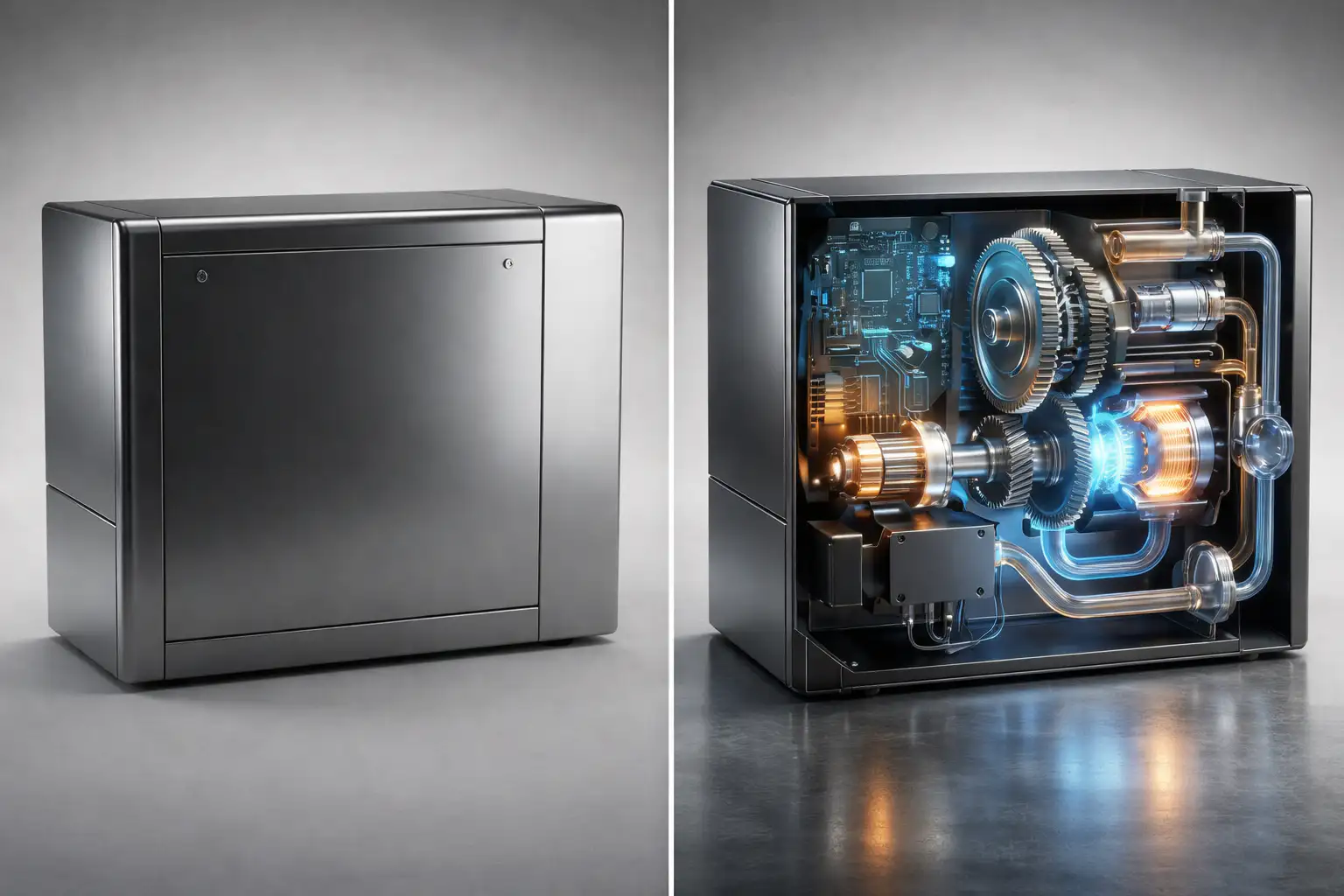
Product Rendering VS Photography
- Author: Cara Lackey
-
November 4, 2025
-
733 words
-
4 minutes
- 3D Animation
- Product Rendering
When cameras fall short
The photo came back beautiful. Studio lighting, perfect angles, high resolution. Your sales team looked at it and asked: “How do we show what’s happening inside?” You didn’t have an answer.
Traditional photography excels with consumer goods. Set up a studio, dial in the lighting, capture the angle. Done. But complex equipment operates by different rules. Heavy machinery can’t fit in a studio. Precision instruments function at scales cameras can’t capture. Products in restricted facilities aren’t available for shoots. And products still in development? They don’t exist yet.
This gap between what photography captures and what complex products need to communicate has pushed manufacturers toward a different approach: building visual assets digitally rather than capturing them optically.
The visibility problem
A camera documents surfaces. It records what light bounces off an object at a specific moment. For complex equipment, that’s often the least interesting part.
Consider what actually sells complex products: internal mechanisms, thermal dynamics, the interaction between components during operation. These details live inside sealed housings or at scales too small or too large for any lens to capture. A data center’s cooling system might span an entire floor. A surgical instrument might have tolerances measured in microns.
How do you demonstrate fluid moving through a system? Show internal mechanisms without disassembling expensive equipment? Create visuals of products six months from manufacturing? Cameras can’t help here.
3D animation fills this gap by building products digitally from engineering data, then visualizing whatever perspective the story requires: cutaways, exploded views, X-ray perspectives, even cross-sections that would destroy the physical product.
The logistics equation
Photo shoots for complex equipment carry hidden costs that compound quickly.
Location fees and crew travel eat into budgets before the first image is captured. Equipment transport requires cranes, flatbeds, and careful coordination. Weather delays reset schedules. A 40-foot piece of machinery needs studio space that often doesn’t exist, or lighting rigs that cost more than the shoot itself.
Environmental constraints make things worse. Clean rooms, data centers, and active production floors have safety protocols that turn simple projects into multi-week productions requiring permits, escorts, and equipment certifications.
The COVID-era experience proved instructive here. When lockdowns prevented on-site shoots entirely, manufacturers with existing CAD data could shift to 3D visualization without skipping product launches. Those dependent on traditional methods faced months of delays.
The digital asset advantage
The economics shift in one fundamental way: the initial investment creates reusable assets rather than one-time images.
CAD-to-animation workflows
Most manufacturers already have the foundation for 3D visualization sitting in their engineering files. CAD models, the digital blueprints used for manufacturing, translate into animation-ready assets. The geometry already exists. The specifications are embedded in the data.
This means visualization can begin before physical prototypes exist. Marketing assets can launch alongside production rather than months after. And when a component changes, the existing digital model updates rather than requiring a reshoot.
Some studios call these “digital twins,” photorealistic replicas that serve as the source for all visual content. Need stills for a brochure? Pull frames. Need a new angle for social media? Render it. Planning trade show content? The foundation already exists.
Where the approach wins decisively
Certain product categories benefit dramatically from digital visualization:
Heavy machinery and manufacturing – Equipment too large or hazardous for studio shoots becomes accessible through precise modeling. Sealed systems and active production lines can be visualized without disrupting operations.
Technology infrastructure – Server architecture, networking equipment, and embedded systems operate at scales or in environments where photography is impractical. Animation reveals internal processes and system interactions.
Aerospace and defense – Internal mechanisms, assembly sequences, and operational concepts require visualization that reveals rather than documents. Products under development or protected by security requirements can still be marketed.
Medical devices – Cutaway views reveal functionality without destroying prototypes. Mechanisms at microscopic scales become visible and understandable.
Pre-production products – Marketing can launch before manufacturing completes. Customers see exactly what they’re buying before it exists.
Building an asset library
The long-term value of 3D visualization compounds over time. Every model created becomes intellectual property available for future use. Product variants use existing geometry. Rebrands change colors without reshooting. New marketing campaigns pull from an established visual library.
A photo shoot captures a moment. Digital visualization builds infrastructure.
The companies gaining ground in product marketing aren’t choosing between these approaches based on preference. They’re recognizing that complex products require visualization tools cameras were never designed to provide.
Let’s discuss your project and explore how visualization from engineering data can transform your product marketing.
About the Author