Animation vs live action: A practical cost comparison
- Author: Cara Lackey
-
December 16, 2025
-
903 words
-
4 minutes
- 3D Animation
- Video Production
The budget question marketing teams actually need to ask
You’re staring at a proposal. One line says “animation.” Another says “live action.” The numbers look different, but they don’t tell you which one will actually work.
Here’s the thing: most cost comparisons miss the point entirely. They stack up production day rates and rendering hours like you’re buying commodities. But video production isn’t a commodity purchase. It’s a strategic investment where the right choice depends on what you’re trying to show, not just what you’re willing to spend.
A 2-minute animated video can cost anywhere from $1,500 for basic motion graphics to $50,000 or more for photorealistic 3D. Live action for the same length? Anywhere from $5,000 for a simple talking-head shoot to well over $100,000 for multi-location productions with talent and equipment logistics. The ranges overlap significantly, which is exactly why cost alone won’t guide your decision.
The real question isn’t which costs less. It’s which one delivers what your message actually needs.
What animation does best
Animation shows what cameras physically cannot capture.
-
Abstract concepts become concrete —
Complex workflows, data relationships, cause-and-effect sequences. 2D animation translates ideas that have no physical form into visual narratives audiences actually follow. Motion graphics turn statistics into stories. Diagrams become demonstrations.
-
Products become visible before they exist —
Prototypes, concepts, future versions. 3D animation lets you demonstrate capabilities, show scale, and present photorealistic detail for products still in development. Launch marketing doesn’t wait for manufacturing.
-
Perspectives become unlimited —
Cutaways, exploded views, microscopic details, impossible camera angles. Animation puts the viewer anywhere the story needs them, without physical constraints on what the “camera” can access.
-
Revisions stay manageable —
When messaging shifts or products evolve, animation assets update through revision rather than reshooting. For companies with frequent updates, this flexibility compounds over time.
What live action does best
Live action builds trust through authenticity that animation cannot replicate.
-
Real people create immediate connection —
There’s a reason executive interviews and customer testimonials work. Eye contact, vocal tone, body language. These signals communicate credibility at a subconscious level. Audiences know the difference between a real person speaking from experience and a constructed message. That authenticity closes deals.
-
Actual facilities demonstrate operational credibility —
When prospects evaluate vendors, they want to see where products are made. They want to observe how teams work together, what the environment looks like, how your operations actually run. Video production captures the texture and energy of real spaces that animation, by design, constructs from scratch.
-
Company culture comes through in real footage —
The specific way your team interacts, the personality of your workplace, the genuine moments between colleagues. These qualities differentiate you from competitors in ways that scripted content cannot. Prospects connect with companies that feel human.
-
Evergreen messages benefit from live capture —
Company values, leadership philosophy, brand positioning. These don’t change quarterly. A well-produced live action piece can serve for years without feeling dated, especially when the focus is people and principles rather than products.
Factors that actually drive the budget
Both mediums have cost variables that initial quotes don’t always surface.
For animation: Complexity drives cost. Simple motion graphics cost far less than photorealistic 3D with accurate physics simulations. Revision rounds add up. Render times for complex scenes extend timelines. The more technical precision your industry requires, the more that verification process with your engineering team factors into the schedule.
For live action: Logistics drive cost. Location scouting, travel, crew accommodations, permits, talent fees. Remote locations add coordination overhead. Weather and operational schedules create variables. Multi-day shoots in multiple locations compound these factors.
Neither medium is inherently cheaper. The question is which set of cost drivers applies to your specific project.
When to consider both
Sometimes the answer isn’t either/or.
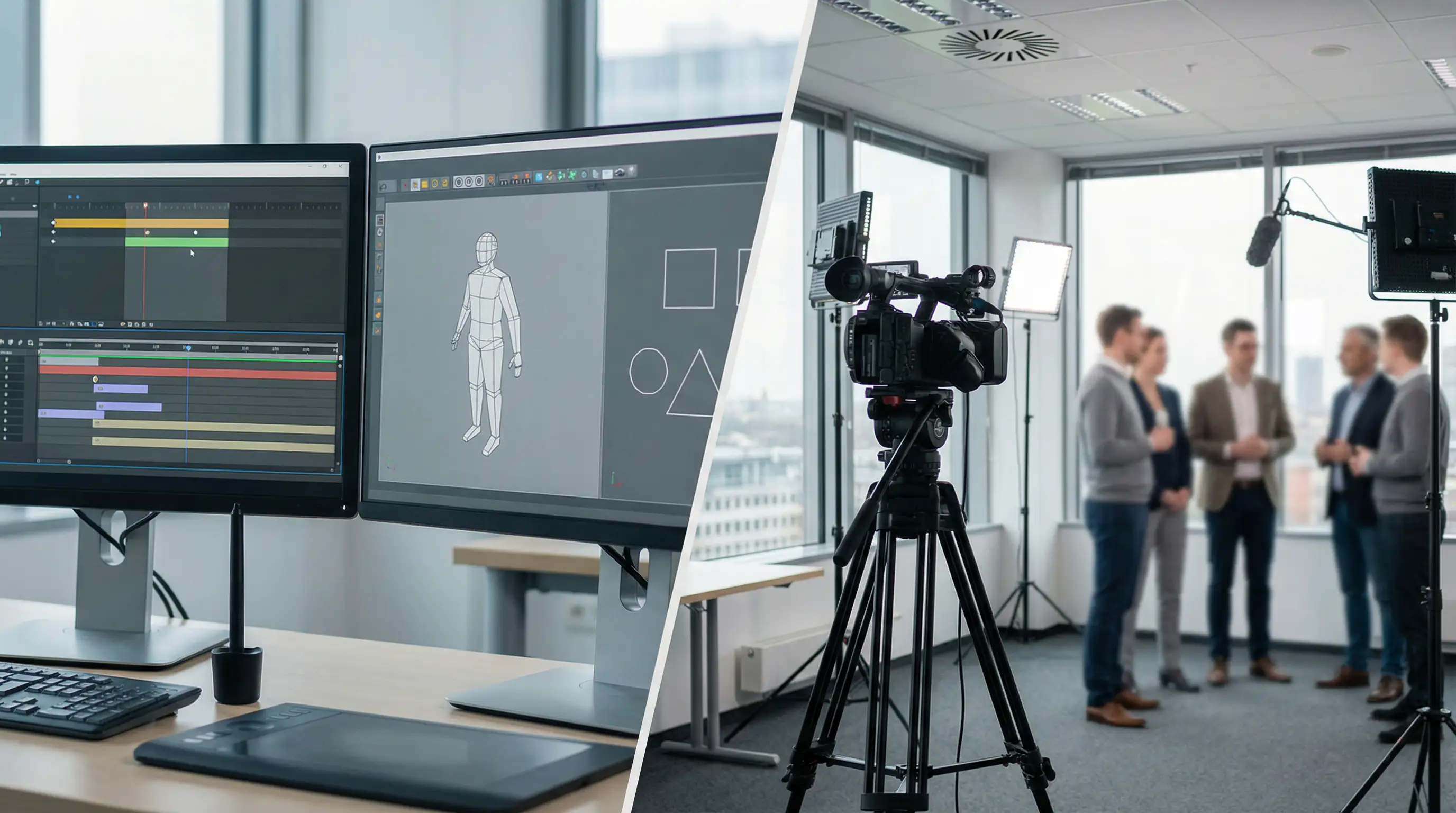
Hybrid productions combine animation and live action in a single piece. The animation handles what cameras can’t capture. The live action grounds the message in human credibility. Two mediums working together, each doing what it does best.
This approach works when your story has two layers: a technical or conceptual element that needs visualization, and a human element that needs authenticity. Product demonstrations paired with customer testimonials. Process explanations paired with team expertise. Technical capability paired with the people who deliver it.
Hybrid productions cost more than single-medium projects. You’re essentially running two parallel workflows. But when your message spans both complexity and credibility, neither medium alone tells the complete story.
Choosing the right approach for your project
The decision comes down to what your message requires to land.
Choose animation when:
- Your subject is underground, sealed, microscopic, or doesn’t physically exist yet
- Technical accuracy requires visualizing processes cameras can’t capture
- Your product line evolves frequently and content needs to stay current
Choose live action when:
- Trust depends on seeing real people, real facilities, or real operations
- Authenticity and human connection drive the buying decision
- Your message centers on culture, leadership, or customer relationships
Consider hybrid when:
- You need to explain invisible technical processes controlled by visible human expertise
- The story requires both “how it works” and “who makes it work”
Neither medium is universally better. Each excels at something the other cannot do.
Schedule a consultation and let’s figure out which approach fits your specific situation. We produce 2D animation, 3D animation, video production, and hybrid combinations for clients in industries from energy to healthcare to tech. The goal isn’t selling you a medium. It’s finding the one that actually delivers what your message needs.
About the Author