3D Animation for Manufacturing: How Industrial Companies Show What Words Can't
- Author: Cara Lackey
-
June 9, 2026
-
Updated:
-
933 words
-
5 minutes
- 3D Animation
- Product Demo
- Trade Show Media
An industrial product that is genuinely impressive often photographs as a featureless lump of metal, and that gap is a sales problem long before it is a marketing one. The most sophisticated equipment tends to be the hardest to explain, and the harder a product is to explain, the longer it sits in a buyer’s evaluation while the case for it never quite lands.
That is the practical reason most manufacturers I work with end up commissioning 3D animation services, and rarely for flashier marketing. A sealed assembly, a buried process, or a part that only reveals its value in motion cannot be shown any other way, which is where the medium starts to earn its place.
What animation does for industrial companies
Industrial equipment has a communication problem. Sales teams can’t talk their way around it. The most technically sophisticated products are often the hardest to explain, and the harder a product is to explain, the longer the sales cycle tends to run.
Invisible internals. Take a pressure-relief valve, a multi-layer gasket seal, or an inline inspection camera. None of these can be photographed in context. Animation reveals how components interact under actual operating conditions, without requiring a physical cutaway model or a controlled lab demonstration.
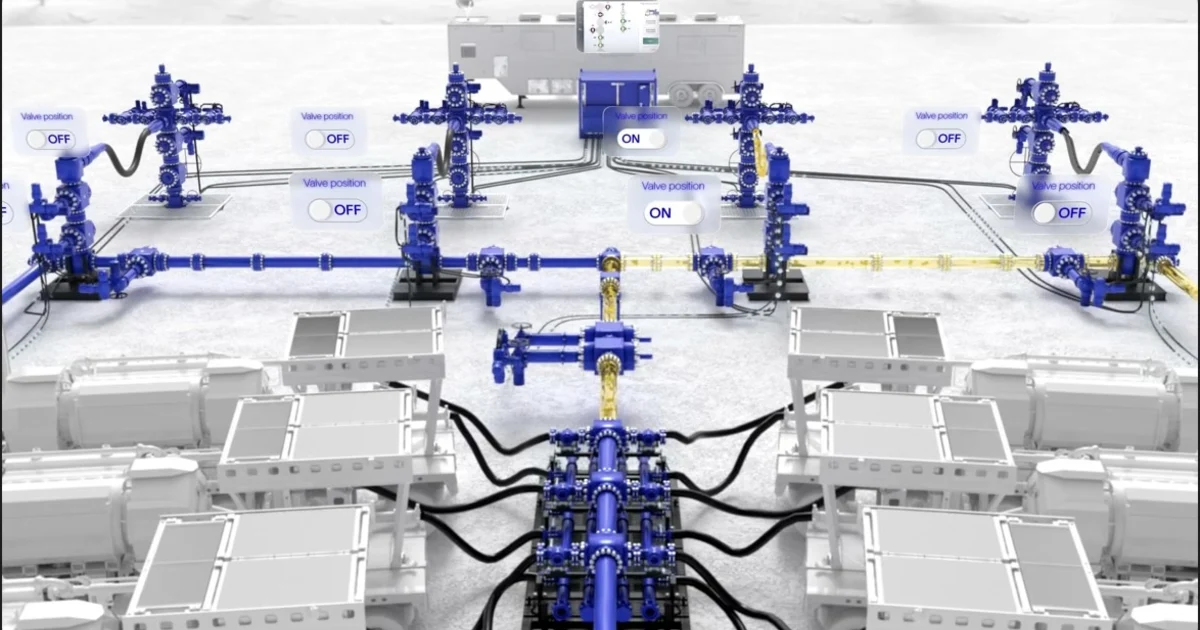
Scale and process flow. A long-form manufacturing process, like natural gas moving through a separator system or an automated inspection sequence traversing a pipeline segment, spans distances and timelines that no single frame can hold. A manufacturing animation video compresses that process into a visual sequence a buyer can follow and retain.
Sales enablement before the first call. Here’s the reality: 81% of manufacturing buyers had already narrowed to a short list before contacting any vendor, according to ISA and RH Blake’s 2026 B2B Manufacturing Buying Journey Research (121 global respondents). Your animation isn’t competing with your sales pitch; it’s competing with every other resource a prospect encounters during self-directed research.
Cutaways, exploded views, and assembly sequences
The techniques that make industrial animation effective aren’t visually spectacular. They are precise, and precision is what engineers and procurement teams respond to.
A cutaway removes exterior surfaces selectively to reveal internal flow paths, component positioning, or mechanical relationships. For work like our Lamons sealing systems project, this is the only way to show why gasket geometry matters at the connection point. Photography captures the part. A cutaway shows the function.
An exploded view separates an assembly into its components, spatially organized to preserve assembly relationships. This works well for product demo videos where buyers need to understand what components they’re evaluating before they understand how those components fit together.
An assembly sequence reverses the explode, showing components arriving and locking into place in order. For capital equipment where installation confidence factors into a purchasing decision, watching an assembly unfold is more persuasive than reading a twelve-step technical manual.
Together, these three moves form the visual vocabulary of industrial “how it works” animation. None of them require the physical product to exist yet, making them equally effective for pre-launch equipment and products still in development.
Not every industrial subject demands 3D. When the topic is a process flow (how product moves through a facility, or which maintenance trigger sends a technician down which path), 2D animation often delivers clarity faster and at lower cost. Abstract data relationships and workflow diagrams translate well into flat visual environments.
3D earns its cost when the subject is a physical object or environment. Any time a buyer needs to understand geometry, clearances, tolerances, or three-dimensional spatial relationships, a 3D model outperforms an illustration. That holds for industrial equipment almost universally, which is why oil and gas and aerospace and defense buyers treat 3D animation as the baseline expectation.
For trade show media, the case tilts further toward 3D. A looping equipment animation with accurate geometry running on a booth monitor does more for qualifying prospects in eight seconds than a flat graphic manages in a full minute.
What a capable industrial animation partner has to understand
There’s a version of industrial animation that looks convincing and communicates wrong. The geometry is clean, the rendering is polished, and an engineer in your target market immediately spots two details that wouldn’t work in the field. That’s a credibility problem no visual quality recovers from.
A capable partner has to understand the subject matter before touching the software. From our Houston base, my team built that foundation with Gulf Coast industrial clients: Amerapex on remote inspection systems, Systel on rugged computing hardware, Dryline Technologies on moisture management equipment, and Lamons on precision sealing. On the Lamons work, tolerances run in the thousandths.
The through-line isn’t the industry. It’s the tolerance for technical accuracy industrial clients require, and that animators without this background consistently underestimate.
The 2026 State of Marketing to Engineers report from GlobalSpec and TREW Marketing, surveying more than 1,000 engineers, found that 70% of engineers prefer the better-known brand when solutions are technically similar. Technically inaccurate animation erodes that familiarity faster than no animation at all.
The same challenge extends into the energy transition. Cleantech companies raising capital face the same invisible-internals problem, and explainer videos for cleantech investors require the same technical accuracy to be credible.
A brief that arrives with clear engineering documentation, accurate component specifications, and a defined audience gets better animation than a vague “make it look impressive” request. That’s not a limitation. It’s how industrial animation is supposed to work.
Talk to my team about your next industrial animation project
Send me the engineering documentation and a clear sense of who needs to understand the product. My team at Motion Giraffx will come back with an approach built around technical accuracy first.
About the Author