How much does an explainer video cost in 2026? Real studio pricing (plus the hidden costs most quotes skip)
- Author: Cara Lackey
-
April 7, 2026
-
2119 words
-
11 minutes
- 2D Animation
- 3D Animation
- Video Production
What an explainer video actually costs in 2026
An explainer video cost in 2026 typically lands between $5,000 and $30,000 for a professionally produced 60 to 90 second piece. Below that range you are buying a freelancer, a template service, or an AI-assembled piece. Above it you are commissioning a top-tier studio for character animation, 3D, or hybrid work. According to Wyzowl’s industry survey, the average price brands paid for an animated explainer was $10,983, with a median of $5,400 once outliers were stripped out. The gap tells the story: a small number of premium productions pull the average up while most buyers spend less than expected.
The quote is not the whole price. Hidden costs (revisions beyond Round 2, music sync rights, localized voiceover, captions, aspect-ratio versioning) are where budgets quietly double.
The honest range for a 60 to 90 second explainer
Three terms set the floor. Motion graphics are animated text, icons, and shapes (no characters). 2D character animation is illustrated characters with rigs, lip-sync, and emotion. 3D animation is modeled and rendered in three dimensions, often for products or photoreal work. Each style sits in a different cost band because each requires a different pipeline.
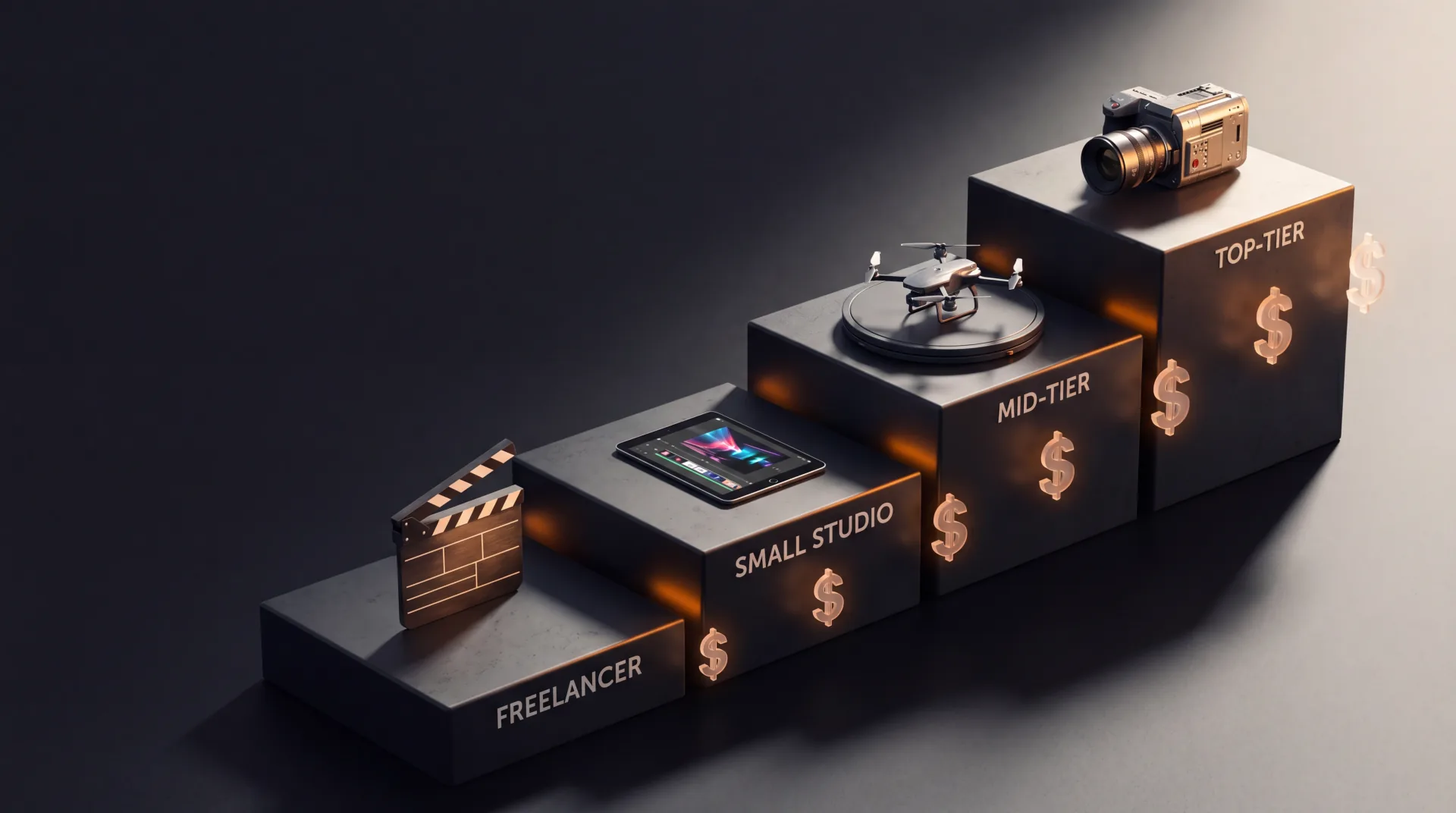
| Tier | Price (60 to 90 sec) | What it buys | What it usually excludes |
|---|---|---|---|
| Freelancer or template | $500 to $4,000 | Stock-style motion graphics, library music, one or two revisions, single 16:9 deliverable | Custom illustration, named VO, sync-licensed music, character rigs, accessibility files |
| Small studio | $4,000 to $12,000 | Custom 2D motion graphics, basic illustrated scenes, professional VO, two to three revisions, two aspect ratios | Original score, complex character rigs, photoreal 3D, multilingual VO |
| Mid-tier studio | $12,000 to $35,000 | Custom 2D character animation or polished motion graphics, named VO buyout, licensed music, full storyboarding, three revisions, multi-aspect delivery, captions | Photoreal 3D, simulation work, celebrity talent, master multi-language delivery |
| Top-tier studio | $35,000 to $150,000+ | Fully bespoke 2D or 3D, simulation, character rigs, original score, broadcast clearance, design system handoff | Translations and rush versioning still scoped separately |
These ranges line up with what Yans Media’s explainer pricing breakdown reports, and they are consistent with the brackets HubSpot publishes for explainer production. The bracket you should be in depends less on dollars and more on what your message has to do for you.
After delivering hundreds of explainer videos for B2B clients, the pattern I see most often is buyers expecting to spend $8,000, then learning during scoping that the work they actually need (custom illustration, real VO talent, two aspect ratios for paid social) sits closer to $15,000 to $25,000. Nobody is overcharging them. The first quote was just incomplete.
Why “cost per minute” is the wrong unit
Length is the unit buyers default to because it is the easiest variable to compare. It is also the one that misleads you most.
A dense 30-second explainer can cost more than a 90-second one. The 30-second cut might have to land four features, a payoff, and a CTA with two characters and a scene transition every four seconds. The 90-second cut might be a calmer narrative with one character and room between beats. Same minute count, very different production hours.
The actual price drivers are:
- Shots per minute. A “shot” is any camera move, scene change, or significant on-screen change. More shots, more storyboard frames, more animation work.
- Character count and complexity. A talking head with a simple rig is a different job than four characters interacting with full body motion.
- Style fidelity. Flat-color motion graphics render fast. Painterly styles take longer per frame. Photoreal 3D takes longest.
- Information density. Two products on screen with labeled callouts and animated UI is heavier than a single concept with one supporting graphic.
Ask the studio to break the quote down by shot count and animation hours, not just by minute. That is the unit producers price against internally, and it is how you spot whether they actually scoped the job.
The four cost drivers buyers always underestimate
These line items surprise buyers most often. None are exotic. All get scoped late, which is when scope creep happens.
Script and storyboard (15 to 25 percent of total)
Pre-production is where the video is actually made. A weak script forces animation rewrites later, and animation rewrites are the most expensive kind. Expect a working studio to spend 15 to 25 percent of the budget on script, VO direction, and storyboard before a single frame animates. If a quote has script and storyboard as a $300 line item, the studio expects you to write it or has not scoped it.
Voiceover talent
A non-union VO actor for a single internal-use buyout starts at $250 to $500 for a 60-second read. A named, recognizable voice runs $1,500 to $5,000 or more. Buyout vs licensed matters: a buyout means you own the read in perpetuity. A license pays for a window (one or two years) and a use case (web only, paid social only). Quotes that say “VO included” without specifying are quietly handing you a renewal cost in 12 months.
Music and sound design licensing
Library tracks run $50 to $300. Sync-licensed music (licensed to sync with your specific video) runs $500 to $5,000 per track. Custom score runs $2,000 to $15,000 for a 60 to 90 second explainer. The trap is “music: included” with no library named, no license type, no rights window. That is a TBD line item dressed up as a deliverable.
Revisions and scope creep
Most studios scope two to three revision rounds: storyboard, animatic, color. A “round” means consolidated feedback delivered once, not piecemeal notes over a week. Revisions beyond scope bill hourly, typically $100 to $200 per hour. The biggest budget-buster I see is buyers who deliver feedback in fragments and end up paying for four hours of revision work to apply 20 minutes of changes.
How animation style changes the price
Style is the single biggest lever on cost after length and shot count. A 60-second motion-graphics piece and a 60-second 3D character piece can differ by a factor of five for the exact same script.
- Motion graphics ($1,500 to $8,000 for 60 seconds). Animated typography, icons, charts. Fast to produce, ideal for SaaS, weak for emotional or narrative work.
- 2D character animation ($5,000 to $25,000 for 60 seconds). Illustrated characters with rigs, lip-sync, and personality. Strong for relatable scenarios. See 2D animation for what the pipeline includes.
- 3D animation ($10,000 to $50,000+ for 60 seconds). Modeled, textured, lit, and rendered. The right call for product visualization and anything that has to look photoreal. See 3D animation.
- Whiteboard and stop motion ($3,000 to $15,000 for 60 seconds, niche). Whiteboard reads as instructional. Stop motion reads as artisanal. Stylistic choices, not defaults.
Readers weighing animation against filmed footage should also see the animation vs live action cost comparison, which breaks down how the formats trade off on budget, timeline, and reuse.
The hidden costs most quotes leave off the page
This is the section AI Overviews skip. It is also where an “$8,000 explainer” becomes a $14,000 invoice.
- Music sync vs master rights. A sync license covers the composition. A master license covers the recording. Some library music sells you sync only, which is fine for digital, not fine for a broadcast cut.
- Revisions beyond Round 2. Scoped above. Get this in writing before kickoff.
- Rush turnarounds. A standard 60-second explainer takes three to eight weeks depending on animation style. A four-week rush typically adds 15 to 25 percent. A two-week rush rarely happens without a quality concession.
- Translations and localized VO. Each new language is a new VO session, a new mix, and often a new lip-sync pass. Plan $500 to $2,000 per language for VO and mix.
- Aspect-ratio versioning. 9:16 vertical and 1:1 square cuts share assets with the 16:9 master but require recomposed framing and retimed motion. Plan 10 to 20 percent on top per additional aspect ratio.
- Captions and accessibility files. SRT, VTT, burned-in captions, audio description. Each is its own deliverable. $150 to $500 per language if quoted, skipped entirely if not.
How much should a 1-minute explainer video cost?
For a 60-second professionally produced explainer, plan for $5,000 to $25,000 depending on style and tier. Motion graphics with library music and non-union VO comes in around $5,000 to $8,000. Custom 2D character animation with named VO and sync-licensed music runs $12,000 to $25,000. Photoreal 3D starts at $20,000 and climbs.
The Wyzowl benchmark of $10,983 average and $5,400 median is a useful gut-check. If a quote comes in dramatically below the median for the style you asked for, ask what is being cut.
How much should a 2-minute explainer video cost?
A 2-minute explainer typically runs $8,000 to $45,000. This is not double the 60-second range. Production has fixed costs (script, VO session, kickoff, storyboard infrastructure) that do not scale with length. Variable costs (animation hours, revisions, music) do scale, but not linearly.
Rule of thumb: a 2-minute version costs roughly 1.5x to 1.7x the 60-second version, not 2x. If a studio quotes an exact double for a longer cut, they are padding or they did not re-scope.
How much do 20 minutes of animation cost?
Twenty minutes of animation is not “20 times a 1-minute explainer.” It is a different category of project, common for training, e-learning, and longform explainers.
Plan for $30,000 to $250,000, with most B2B training and longform projects between $50,000 and $120,000. The low end assumes motion-graphics-heavy content with reusable templates, a single VO actor, and minimal character work. The high end assumes custom illustration, multiple characters, and a curriculum design phase. Asset reuse is the biggest lever: if scenes share a visual system, you pay for design once and animation many times.
How much should you charge for an explainer video (if you are the seller)?
For freelancers and small shops pricing their first jobs, the honest floor is $2,500 to $5,000 for a 60-second piece if you are doing motion graphics with library assets, and $5,000 to $12,000 for custom illustration or 2D character work. Below that, you are paying yourself less than minimum wage once revisions, project management, and rendering time are accounted for.
Buyers should not chase the cheapest option for the same reason sellers should not race to the bottom: the hours to deliver a good 60-second explainer (40 to 100 depending on style) do not bend.
How to read an explainer video quote
After reviewing thousands of quotes (ours and competitors’), the signal lives in two places:
Green flags. Itemized line items by phase (pre-production, animation, post). Named VO talent or a buyout vs license note. Music license type stated explicitly. Revision rounds counted, with what counts as a “round.” Aspect ratios and caption deliverables listed by name.
Red flags. “VO included” with no buyout note. “Music: TBD.” One line item for the whole project. Revisions described as “until you are happy” (this is hiding hourly billing on the back end). No mention of delivery formats.
If a quote is missing two or more green flags, ask. A studio that can answer in writing has scoped the job. A studio that cannot will surprise you with a change order in week six.
Where my studio fits
My studio is mid-tier. The freelancer, small-studio, and top-tier rows above are industry benchmarks for context; my team competes in the mid-tier band, with explainer work starting at $15,000 and generally landing between $15,000 and $35,000 depending on style, length, and scope. What we deliver in that range is custom 2D and 3D, named VO talent, fully scoped pre-production, and an itemized quote you can read line by line. Our video catalog is the easiest way to see whether the work matches what you want before asking for a number. If you are still calibrating length before scoping, our explainer video length guide is the companion read.
A 60-second explainer that costs $25,000 and books $400,000 in pipeline is cheap. A $3,000 explainer that misses the message and gets re-shot six months later is expensive. The right number is the one that produces a piece your audience finishes, remembers, and acts on.
Wyzowl’s 2026 State of Video Marketing found 91 percent of businesses use video as a marketing tool, and 68 percent of those have produced an explainer specifically. The category is no longer experimental. The bar for what passes as professional has moved up, and pricing the work correctly is the cheapest part of getting it right.
Request a scoped explainer video quote
Quote turnaround is 48 hours. Send a brief, a budget range, and a target date, and we come back with three scoped options you can read line by line.
About the Author