Four constraints that decide what your product animation actually gets built
- Author: Cara Lackey
-
August 18, 2026
-
1319 words
-
7 minutes
- 3D Animation
- Product Demo
- Product Rendering
The hardest product animation we get asked for is usually the one where nothing happens. A gasket or a length of pipe does its whole job by sitting still and not failing. There is no mechanism to open up and no sequence to follow. Every decision about how to shoot it has to come from somewhere other than the product.
Most briefs do not supply that somewhere else. They describe the product in detail and never say what the viewer has to understand by the end. The feature list becomes the sequence by default.
This post covers the four blockers that put filming off the table, what each does to your style, script, and quote, and which one wins when two collide. Naming the right one early matters more than it sounds. The wrong call stays invisible until the model is built, and correcting it then means a rebuild instead of an adjustment.
The four constraints
One line usually does all the justifying in these briefs, and it is some version of we cannot film it. That line is true and close to useless, because it names an absence rather than a requirement.
Four unrelated situations produce it. A pump two miles underground cannot be filmed because no camera survives down there. A prototype cannot be filmed because there is nothing yet to point a camera at. Both briefs arrive with the same reference video and the same runtime, though one needs accurate simulation and the other needs to avoid promising a design that might change.
Each blocker changes the script, the style, and the quote. A brief that does not say which one you have is guessing at all three.
The product does not exist yet
Pre-launch hardware, unbuilt vehicles, and designs that are not frozen sit here. The object can still change after you have animated it. Every frame commits you to a design engineering has not signed off on.
Natilus needed investors to see a cargo aircraft that did not exist. Amerapex had to demonstrate Hexis, an automated system for cleaning and inspecting heat exchanger tubes, while it was still a semi-functional prototype.
A prototype product animation therefore gets scoped around the freeze date, not around taste. If you need hero stills instead of a sequence, that is 3D product rendering, and we compared renders against photography separately.
The brief has to state the date the design freezes. Until it is written down, your schedule carries a commitment nobody has agreed to.
The product works where nobody can watch
A frozen design still leaves the question of whether anyone can watch the thing work. Downhole tools, sealed vessels, and conditions nobody can schedule sit here. No camera reaches the moment that matters. The video has to rebuild it from physics, and the accuracy of that rebuild is the whole product.
Cavins Corp put it plainly, since downhole tools operate where cameras cannot capture. The answer was cutaway views, particle simulation, and directional flow indicators. Power Sentry equipment only proves itself during the storm nobody can summon on demand.
Simulation becomes a real line item, and most of the budget moves into work that never shows up in a storyboard. We price industrial 3D product animation on the physics involved, not the runtime, and the cutaway techniques behind it get their own post.
The brief has to name the one physical phenomenon the viewer should walk away understanding, whether that is flow, load, pressure, or current.
The advantage is the part you cannot show
Both constraints so far push toward showing more. This one pushes the other way, because the reason to animate the product is also the reason you cannot show it. Whatever makes the thing work is what a competitor would most like to look at. An accurate render hands it to anyone willing to pause the video. Every gain in fidelity raises what you disclose, which turns realism into a measure of exposure instead of quality.
Stylization becomes the correct answer here, not the cheap one, and the research agrees. Tversky, Morrison and Bétrancourt’s review found a simple graphic keeping only the essential idea frequently beats a realistic one. That is uncomfortable for a studio that sells photorealism, and we plan around it anyway.
We considered 3D for Exum Instruments and rejected it, since it gave away too much of their IP, and a stylized 2D animation explained the internals instead. Dryline Technologies asked us not to show the internals of patent-pending equipment at all.
That boundary also moves, since a US patent application normally publishes 18 months after filing.
The brief has to state the disclosure boundary, in writing and dated, before anybody picks a style.
The product does not visibly do anything
The last one is the one people underestimate. Gaskets, housings, and static assemblies land here, along with most of the 3D animation for industrial equipment we quote. A sequence is what normally holds a viewer for sixty seconds, and these products do not supply one. That leaves framing, pacing, and context to carry the attention by themselves.
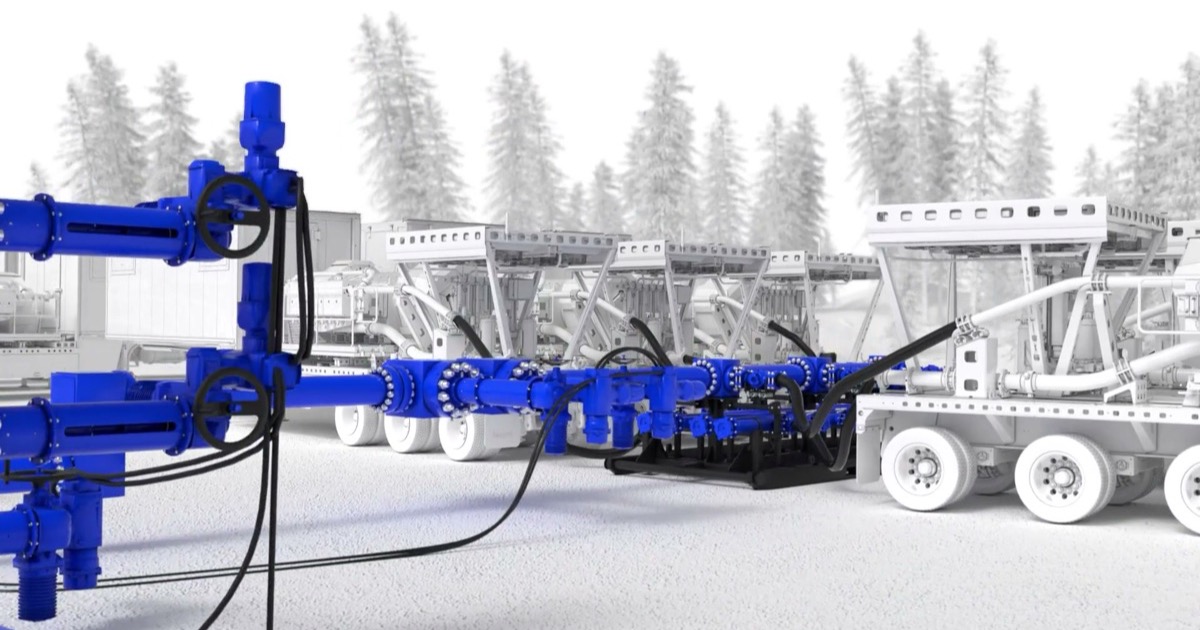
The Lamons CorrLock gasket was, in our own published words, simple and then too simple, since a metal disk had to hold attention for over a minute. For NOV’s flowback system, we wrote down the question of how to make a flythrough exciting when nothing is really being animated.
This is also the one where animation is not automatically the stronger format. Höffler and Leutner pooled 26 studies in 2007 that put moving visuals against still ones. Averaged across all of them, animation won by an effect size of 0.37, which is a real edge but a modest one. Where the material was procedural, meaning the viewer had to learn a set of steps in order, that edge jumped to 1.06, near three times as large. Motion earns its cost when there is an order of operations to teach. A gasket does not have one.
The brief has to say where it plays and what the viewer already knows when it starts. A trade show loop and a sales-call asset are not the same video.
Which constraint wins when two collide
Most projects carry two of these at once, and naming both is not the same as deciding. A tie only moves the argument to the storyboard review, where it costs more to lose.
What breaks the tie is that the four are not the same kind of limit. The sealed environment and the static product push toward photorealism, which is a preference. The unfrozen design and the disclosure boundary push toward abstraction, and both are hard limits set by someone other than marketing. One expires on a date engineering controls, and the other is set by counsel. When a photorealism constraint collides with an abstraction constraint, abstraction wins. Show less than you could and nothing breaks. Show more than the law allows, or more than the frozen geometry supports, and you have published something you cannot take back.
That ranking is also the order to settle the brief in, hardest line to reverse first.
- State the disclosure boundary in writing.
- State the date the design freezes.
- Name the physical phenomenon the viewer must understand.
- Say where the video plays and what the viewer already knows.
Work down the list and stop at the first line that binds you. That is your primary constraint, and it has already made the style call.
Lamons brought us both halves of that rule. H2scan, their hydrogen leak detector, had a design that was not final. It never appears in its own launch campaign. The CorrLock gasket carried no hard limit, and photorealism did the work.
Those four lines are a twenty-minute internal conversation, and writing them down before the reference video settles the style argument. Our ranges sit on the pricing page.
Send us the constraint and get a scoped quote
Bring the blocker, not the spec sheet. We will tell you which of the four you are solving for and what the product demo costs to build.
About the Author